





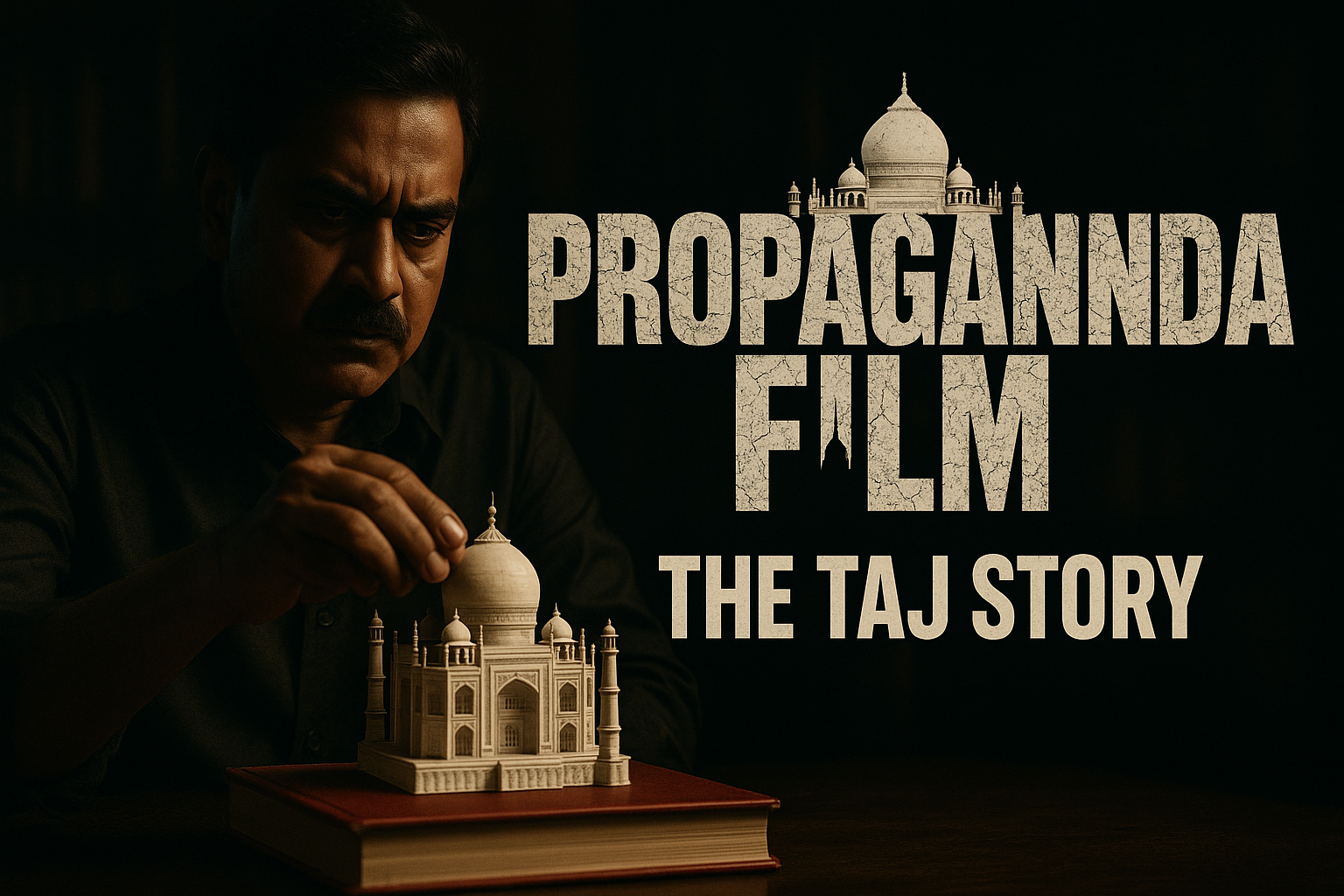
The Taj Mahal, one of the Seven Wonders of the World and a global symbol of love, has once again fallen victim to propaganda. The 2025 Hindi-language film The Taj Story, written and directed by Hindutva supporter Tushar Amrish Goel and produced by CA Suresh Jha under Swarnim Global Services Pvt. Ltd., claims the monument is not a mausoleum but a Shiva temple called “Tejo Mahalaya.” Goel, who previously directed the BJP-backed flop Modi Kaka Ka Gaon (aimed at polishing Narendra Modi’s image), is now pushing this narrative to challenge Mughal emperor Shah Jahan’s historical legacy. The film alleges it was built in the 13th century by Raja Paramardi Dev and later seized by Shah Jahan from Raja Jai Singh’s grandson.
But do these claims hold up against historical records, architectural evidence, and logic? Based on well-documented facts, this film is pure propaganda. Due to the BJP’s growing Hindutva extremism and cultural coercion, even top Bollywood actors are often forced to star in such films to prove themselves as “good Hindus” and avoid backlash or boycotts. Let’s examine the evidence.
1. Historical Records: Mughal Documentation Speaks Clearly
Official chroniclers from the Mughal era, such as Abdul Feroz, Mirza Najaf Ali, and others, explicitly state that the Taj Mahal was constructed by Shah Jahan in memory of his wife Mumtaz Mahal between 1632 and 1653. Administrative orders and departmental letters from the time of Asaf al-Rahim detail Shah Jahan’s approvals and funding. The Mughal treasury’s accounts record construction expenses under Shah Jahan’s name.
If the Taj were a pre-existing Hindu temple, why is there no mention of Raja Paramardi Dev or “Tejo Mahalaya” in any Mughal records? Contemporary Mughal accounts, including journals and court histories, confirm the Taj’s construction as a royal project.
2. Architectural Evidence: Pure Mughal Style
Shah Jahan’s name is inscribed in Persian and English on the minarets, entrance gates, and marble slabs inside the Taj Mahal. The chief architect, Ustad Ahmad Lahauri, was appointed by Shah Jahan himself, as noted in historical documents.
The structure’s features—domes, minarets, intricate marble work—are hallmarks of Mughal architecture, matching other Shah Jahan-era monuments like Delhi’s Jama Masjid and Red Fort. If it were a 13th-century Hindu temple, carbon dating and design would reflect pre-17th-century styles—but archaeological experts confirm otherwise.
3. Logic and Reason: Resources and Power Required
The Taj Mahal was an extraordinarily grand and expensive project. Historical estimates put the cost at 32–42 million rupees (e.g., the marble foundation and four minarets alone cost around 5,177,674 rupees and 7 annas). Funding came from the Mughal treasury and provincial taxes from the Agra district, with a waqf endowment generating annual income of about 300,000 rupees from 30 villages.
- Where did the resources come from? Only the Mughal empire’s political power and treasury could support such a venture.
- If built by a Hindu king? Why do Mughal records credit Shah Jahan? Why are post-construction approvals in his name?
- Labor and Artisans: Around 20,000 workers, skilled craftsmen, and artists (from local areas and abroad, including Persia, Afghanistan, and Central Asia) were involved. The Mughal government provided housing, food, and medical facilities. The film’s implied cruelty (e.g., myths of hands being chopped off) is baseless—no historical or archaeological evidence exists. In fact, these same workers later built Shahjahanabad (modern Delhi).
4. Popular Misconceptions and Rebuttals
- The 22 Closed Rooms: Propaganda claims Hindu idols are hidden inside. Reality: These are basement corridors providing structural support (similar to Humayun’s Tomb or Safdarjung Tomb). The Archaeological Survey of India (ASI) has released photos showing restoration work—nothing more. Courts have dismissed multiple petitions (2015, 2017, 2022) calling them a mockery of the legal system.
- Tejo Mahalaya Claim: Originated from P.N. Oak’s 1989 book, a self-styled “historian” who fabricated wild theories (e.g., calling the Vatican a Hindu temple). Courts ridiculed his petitions as “misconceived.”
- Raja Jai Singh’s Land: Shah Jahan did not seize it forcefully; he exchanged it for four mansions in 1633 (records preserved in Jaipur’s City Palace). The families had close ties dating back to Akbar’s era.
Summary: Propaganda vs. Facts
| Aspect | Film’s Propaganda Claim | Actual Evidence |
|---|---|---|
| Builder | Raja Paramardi Dev (13th century) | Shah Jahan (1632–1653) – Mughal records |
| Purpose | Shiva Temple (Tejo Mahalaya) | Mumtaz Mahal’s mausoleum – Contemporary accounts |
| Cost/Funding | Unknown | 32–42 million rupees, Mughal treasury |
| Labor | Hands chopped off | 20,000 artisans settled in Taj Ganj |
| 22 Rooms | Hidden Hindu idols | Structural corridors, ASI photos |
The Taj Mahal is a Mughal architectural gem and UNESCO World Heritage Site. Films like The Taj Story thrive on WhatsApp-era rumors stemming from fabricated tales like P.N. Oak’s. History is built on facts, not emotions or forced narratives. Amid rising Hindutva pressure from the BJP, such propaganda forces industry stalwarts into these projects to safeguard their careers. The Taj belongs to India’s shared heritage—celebrate it as a symbol of love, not division.