





The announcement of the FY 2025-26 federal budget, with an outlay of approximately PKR 18.7 trillion, marks another year where Pakistan’s economic roadmap is dictated by the IMF rather than national interest. While politicians remain embroiled in power struggles and “Elite Capture,” the fundamental mechanics of the economy are grinding to a halt. We are no longer a country with a budget; we are a debt-servicing machine with a country attached to it.
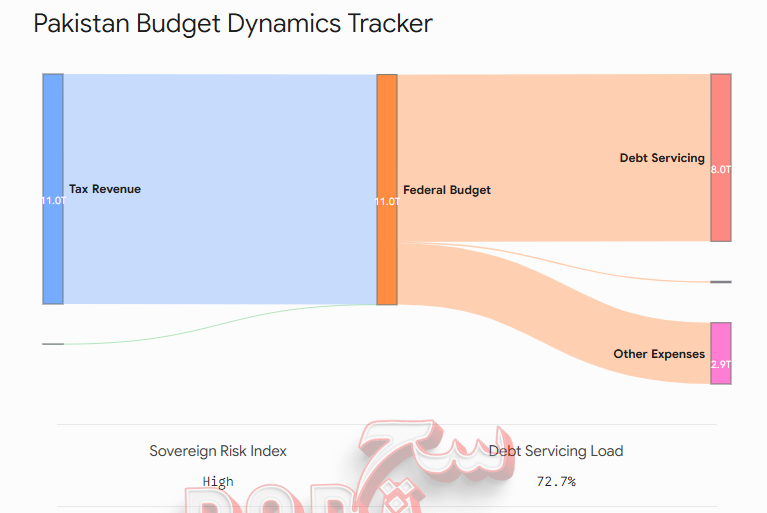
1. The Math of Despair: Debt Servicing vs. Human Capital
The most staggering figure in the current budget is the PKR 8 trillion allocated for debt servicing.
-
The 45% Drain: Nearly half of the total budget is gone before a single rupee is spent on the public.
-
The Revenue Gap: This debt payment consumes roughly 70% of the FBR’s total tax collection.
-
The Opportunity Cost: While trillions exit the country to pay off interest, a measly PKR 25 billion is left for Health and PKR 46 billion for Higher Education. This reflects a state that has prioritized past mistakes over future generations.
2. Structural Cancers: Why Pakistan is Getting Poorer
A. The “Circular Debt” & Capacity Payment Trap
The Circular Debt (Gardishi Qarza) has ballooned past PKR 2.6 trillion (26 kharab rupees). Pakistan is trapped in predatory contracts with Independent Power Producers (IPPs).
-
The Root Cause: Under “Capacity Payment” clauses, the government is legally obligated to pay billions of dollars to these power companies for electricity we don’t even use, simply because of flawed contracts.
-
The Impact: To fund these unutilized charges, the government relentlessly inflates the public’s bills through “Fuel Adjustment Charges” and heavy taxation. This is actively shutting down local industries and pushing the middle class into extreme poverty.
B. The Real Estate Curse: Frozen Capital
Pakistan’s domestic wealth is aggressively parked in unproductive land speculation (“Plotting”) rather than industrial growth.
-
The Problem: If a wealthy individual accumulates PKR 100 million, they buy 5 real estate plots instead of setting up a manufacturing plant. Land speculation increases individual wealth but creates zero industrial productivity, zero real jobs, and zero long-term employment.
-
The Policy Gap: By failing to tax vacant land heavily and incentivize manufacturing, the state allows billions to remain permanently “frozen” in the soil while the economy starves for investment.
C. Brain Drain & The Education-Economy Mismatch
In the last two years, over 1.5 million (15 lakh) skilled professionals (doctors, engineers, IT experts, and scientists) have permanently left the country.
-
The Loss: We are exporting our most valuable asset—intelligence. The Pakistani state bears the heavy financial cost of their education, but foreign economies reap 100% of the economic benefits.
-
The Root Cause: Our educational institutions operate as factories producing unemployable degree holders. The university curricula are 20 years out of date and completely disconnected from modern global market demands, triggering an unprecedented crisis of “Educated Unemployment.”
D. Trade Deficit and “Import-Led” Growth
We are a nation structurally dependent on others for our basic survival needs, resulting in a permanent economic imbalance.
-
Luxury Imports: Whenever the country secures a temporary influx of dollars, the ruling elite immediately burns it on importing luxury vehicles, premium smartphones, and high-end consumer goods instead of capital machinery.
-
Low-Value Exports: Our export portfolio is fundamentally weak. We sell cheap raw materials like raw cotton and rice, while the rest of the world sells high-margin technology. Dollars bleed out faster than they come in.
E. The Absence of “Ease of Doing Business”
The structural architecture of our state actively repels investment and strangles local entrepreneurship.
-
Bureaucratic Red Tape: To establish even a modest manufacturing factory, an investor faces systemic extortion across dozens of government departments and requires over 50 separate No-Objection Certificates (NOCs). This corrupt system terrifies local and foreign investors alike, causing tax revenues to vanish and leaving the state with no option but to borrow more.
3. The Elite Capture: Subsidies for the Rich, Taxes for the Poor
While the salaried class is taxed at the source, the most powerful sectors—Large-scale Agriculture, Sugar, and Fertilizer—enjoy massive subsidies and tax exemptions.
-
The 13x Inequality: The salaried class pays 13 times more tax than the retail sector.
-
Bureaucratic Profligacy: While 2.7 crore people fell below the poverty line in the last six years, administrative expenses for the bureaucracy and elite protocols increased by 65%.
4. The Pension Time-Bomb
By 2027, Pakistan will spend more on pensions than on its entire Development Budget (PSDP).
-
Demographic Crisis: Currently, 7% of the elderly population receives more from the state than what is spent on the infrastructure for the other 93%.
-
The 2050 Forecast: Without immediate reform to a contributory model, pensions will consume 50% of the entire budget by 2050.
5. The Way Forward: Beyond IMF Dependency
If Pakistan is to break the “Beggar’s Cycle,” we must move beyond “IMF-centric” budgets and execute radical reforms:
-
Renegotiate IPP Contracts: The state must revisit “Capacity Payments” to bring down energy costs for local industries.
-
Tax the Untouchables: Bring the retail sector and large-scale commercial land owners into the tax net. Agriculture must contribute its fair share to the GDP through heavy penalties on vacant plots.
-
Export-Led Industrialization: Move away from raw materials and transition into High-Value Manufacturing (Electronics, Advanced Machinery). Use the IT sector’s 19.8% growth as a blueprint to incentivize high-value tech and service exports.
-
Population Management: With a 2.5% growth rate, no amount of budgeting can keep up with the 5 million new mouths to feed every year. National awareness is a fiscal necessity.
Pakistan is at a crossroads. We can continue to be a state that borrows to pay interest, or we can become a state that taxes its elite to invest in its youth. If the current trajectory continues, the “Poverty Bomb” will eventually explode, leading to a collapse that no amount of foreign aid can fix. The time for “political gains” is over; the time for national survival is now.
Research Note: Data compiled from Federal Budget Documents 2025-26, PIDE (Pakistan Institute of Development Economics) reports, and World Bank economic outlooks.