
In this article
- Introduction: The Chopper Ride That Shook South Asia
- The Architecture of Control: Fifteen Years of the Iron Rule
- The Spark: From Traffic Safety to Quota Reform
- The Interim Era: Muhammad Yunus and the Search for a New Bangladesh
- The February 2026 Election: A New Political Chapter
- The Exile in New Delhi: India and the Bangladesh Question
- The Legal Reckoning: The International Crimes Tribunal
- What It Means Today: Can Bangladesh Build a Sustainable Democracy?
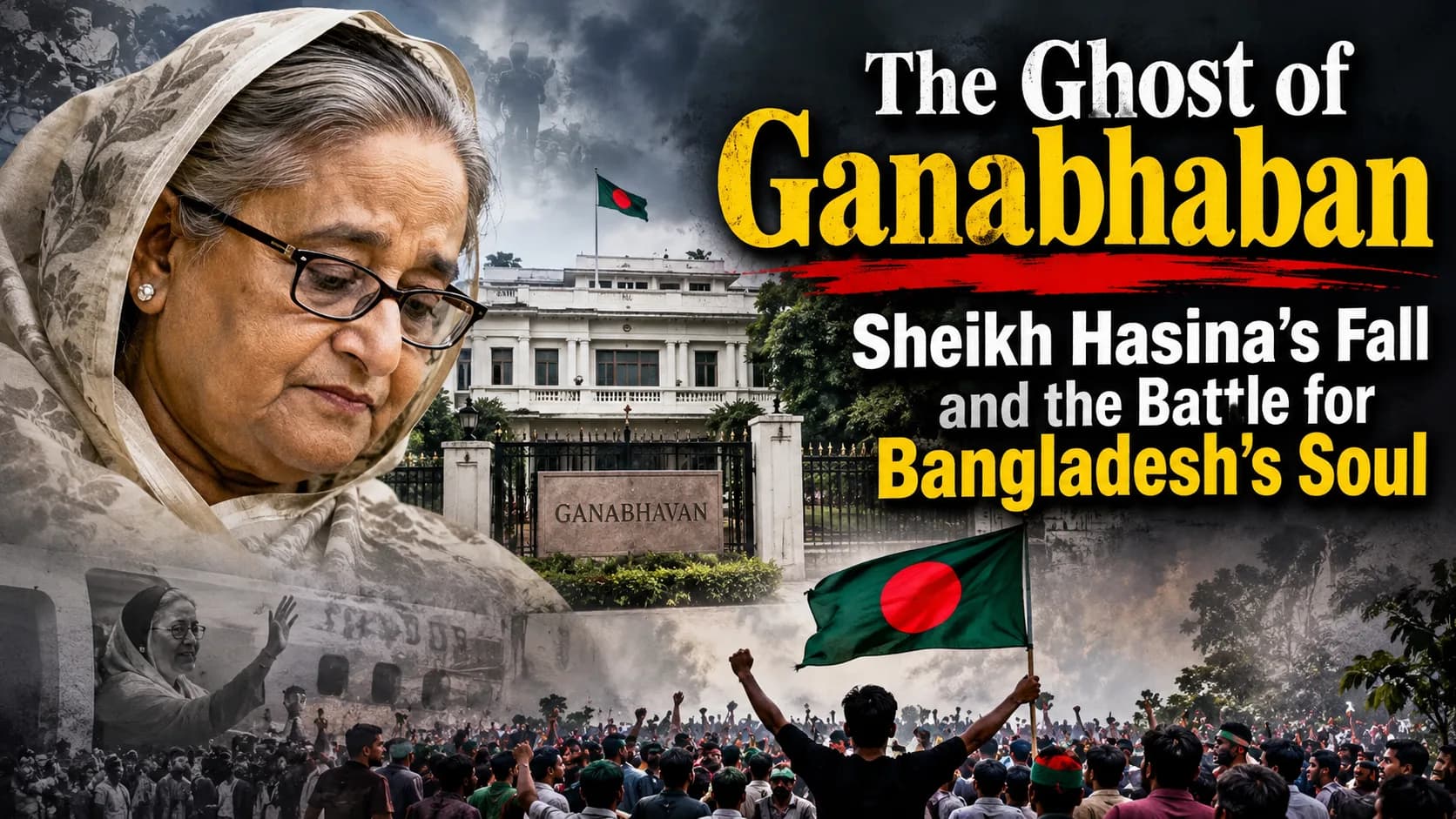
- The Ghost of Ganabhaban
The Sheikh Hasina exile Bangladesh crisis remains one of the most significant political developments in South Asian history. Her dramatic departure to India on August 5, 2024, ended fifteen years of Awami League rule and triggered a historic political transformation. Fore more information about Hasina The Iron Throne of Dhaka: Hasina’s Brutal Rule
What began as a protest against government job quotas soon evolved into a nationwide movement against political repression, disputed elections, corruption, and the concentration of state power. The dramatic departure of Sheikh Hasina from Ganabhaban marked the end of an era, but it also opened a new chapter of uncertainty for Bangladesh.
More than two years later, the question of Sheikh Hasina's exile remains central to Bangladesh's political debate. Her continued stay in India, the legal proceedings against her, and the emergence of a new elected government have transformed the crisis into a wider struggle over justice, democracy, and national identity.
Introduction: The Chopper Ride That Shook South Asia
On August 5, 2024, an extraordinary scene unfolded in Dhaka. Sheikh Hasina, Bangladesh's longest-serving prime minister, left Ganabhaban, her official residence, as thousands of protesters advanced towards the heart of the capital. Within hours, the woman who had dominated Bangladeshi politics for fifteen years was no longer in power. She departed by helicopter for India, bringing an abrupt end to her government and triggering one of the most consequential political transitions in South Asian history.
The images of the uprising were remarkable. Young demonstrators entered the prime minister's residence, crowds celebrated in the streets, and symbols of a political establishment that had appeared unshakable were suddenly exposed to public anger.
But Hasina's departure was not simply the result of a dispute over government employment quotas. It was the culmination of years of accumulated frustration involving political exclusion, disputed elections, allegations of corruption, enforced disappearances, restrictions on free expression, and the increasing concentration of power within the state.
What began as a student movement gradually transformed into a nationwide uprising. The central question was no longer how government jobs should be distributed. It was whether Bangladesh could continue under a political system that large sections of its population believed had stopped representing them.
The departure of Hasina did not resolve that question. It opened an entirely new chapter in Bangladesh's struggle over democracy, accountability, national identity, and political power.
The Architecture of Control: Fifteen Years of the Iron Rule
Sheikh Hasina's political dominance was built on a combination of historical legitimacy, economic development, institutional influence, and increasingly controversial methods of maintaining power.
As the daughter of Sheikh Mujibur Rahman, Bangladesh's founding leader, Hasina inherited a powerful political identity associated with the country's independence struggle in 1971. Her Awami League positioned itself as the principal guardian of that historical legacy, frequently portraying political opposition as a threat to the ideals of liberation.
During her years in office, Bangladesh recorded substantial economic expansion. Infrastructure projects, electricity generation, garment exports, and urban development contributed to a changing national economy. International observers frequently described Bangladesh as an emerging development success story.
However, economic growth did not automatically translate into political freedom or institutional accountability.
The parliamentary elections of 2014, 2018, and 2024 became major sources of controversy. The 2014 election was boycotted by the principal opposition Bangladesh Nationalist Party (BNP), while the 2018 and 2024 elections faced widespread allegations of irregularities and restrictions on opposition participation.
Over time, critics argued that the distinction between the ruling party and the institutions of the state had become increasingly blurred.
The judiciary, police, intelligence agencies, and other state institutions faced allegations of political influence. Opposition activists reported arbitrary arrests, intimidation, and enforced disappearances. Independent journalists and civil society organisations also faced pressure.
Economic governance presented another contradiction. While headline growth figures suggested progress, concerns grew over non-performing loans, banking-sector irregularities, capital flight, and the concentration of economic opportunities among politically connected interests.
The result was a system in which visible development coexisted with growing public distrust.
The issue was not that Bangladesh had experienced no economic progress. Rather, it was whether that progress could remain sustainable without transparent institutions, independent oversight, and meaningful political competition.
The Spark: From Traffic Safety to Quota Reform
The 2024 uprising did not emerge from nowhere.
In 2018, students had already mobilised against the government employment quota system. The controversy resurfaced in June 2024 after a High Court decision reinstated a quota arrangement for public service recruitment.
The original system reserved a substantial proportion of government positions for particular categories, including descendants of freedom fighters. Although supporters viewed these provisions as recognition of historical sacrifice, opponents argued that the system restricted opportunities for merit-based recruitment, particularly for young graduates facing an increasingly competitive job market.
For many students, government employment represented economic security and social mobility. They questioned why access to these positions should depend so heavily on inherited categories rather than competitive examinations.
Initially, the movement demanded reform rather than regime change.
However, the government's response transformed the political character of the protests.
Violent confrontations, attacks on demonstrators, arrests, and the deployment of security forces intensified public anger. The situation escalated dramatically during July, particularly after protesters and their supporters faced lethal force.
The United Nations Human Rights Office subsequently conducted an independent investigation into the events between July 1 and August 15, 2024.
Its February 2025 findings estimated that as many as 1,400 people may have been killed during the unrest. The report identified reasonable grounds to believe that the former government, security and intelligence apparatus, and violent elements associated with the Awami League had systematically committed serious human rights violations.
These included extrajudicial killings, arbitrary detention, torture, and other abuses.
The killing of student Abu Sayed in Rangpur became one of the defining images of the uprising. Video footage showed him standing with his arms spread before police gunfire struck him. His death became a powerful symbol of the protesters' struggle.
The movement also demonstrated a new form of political mobilisation.
Young Bangladeshis used social media, digital communication networks, and decentralised organisation to circulate information, coordinate demonstrations, and challenge official narratives. Internet restrictions and communication disruptions failed to extinguish the movement.
As protests expanded beyond university campuses, the original demand for quota reform gave way to a broader call for political accountability.
By August 5, the government had lost control of the situation.
The revolution had succeeded in removing Hasina, but the difficult work of rebuilding the country was only beginning.
The Interim Era: Muhammad Yunus and the Search for a New Bangladesh
On August 8, 2024, Nobel Peace Prize laureate Muhammad Yunus assumed leadership of an interim administration as Chief Adviser.
His appointment represented an attempt to move Bangladesh away from the political structures associated with Hasina's government while preparing the country for a new electoral process.
Yunus inherited a complicated situation. The administration faced public demands for justice, institutional reform, economic recovery, and the restoration of confidence in government.
Several reform initiatives were introduced, addressing the constitution, judiciary, electoral system, police, public administration, and anti-corruption institutions.
The broader objective was to prevent the political system from returning to the same concentration of power that had contributed to the uprising.
However, the interim period was far from straightforward.
Political parties disagreed over the speed and scope of reforms, while questions emerged over the future role of the Awami League and the treatment of its supporters.
The BNP, Jamaat-e-Islami, and emerging political movements competed for influence in a rapidly changing political environment.
The ban on Awami League activities and the suspension of its electoral registration in May 2025 became particularly contentious. Supporters of the restrictions argued that accountability was necessary following the repression of 2024. Critics warned that excluding a major political organisation could undermine political pluralism and create another precedent for political exclusion.
The interim government also faced difficulties maintaining law and order. Retaliatory attacks, political violence, and concerns about the protection of religious and minority communities demonstrated that removing a government did not automatically eliminate the conditions that had produced political instability.
Yunus eventually handed over power following the February 2026 general election.
The February 2026 Election: A New Political Chapter
Bangladesh's February 12, 2026 general election marked a major milestone in the post-Hasina transition.
The Bangladesh Nationalist Party won a parliamentary majority, and its leader, Tarique Rahman, was sworn in as prime minister on February 17.
The Jamaat-e-Islami secured the second-largest number of votes and entered parliament as the principal opposition.
The election was widely regarded by international observers as a credible and competitive electoral process. The transition from the interim administration to an elected government was reported to have taken place peacefully.
However, the election also exposed an important contradiction.
The Awami League, which had governed Bangladesh for fifteen years, was prohibited from participating. Its political activities remained restricted, and its supporters were unable to contest the election under the party's banner.
This raised an important question about the meaning of democratic restoration.
Can a country establish lasting democracy while excluding a major political organisation, even when that organisation's former leadership faces serious allegations of human rights violations?
There is no simple answer.
Individuals responsible for crimes must face accountability. At the same time, political responsibility cannot automatically be extended to every member or voter of a party.
Bangladesh's new political leadership now faces the challenge of demonstrating that democratic principles apply equally to political allies, opponents, and former rulers.
The Exile in New Delhi: India and the Bangladesh Question
Hasina's departure created a diplomatic challenge for India.
New Delhi had maintained close relations with her government for years. Cooperation included security arrangements, trade, connectivity, and regional strategic interests.
Her continued presence in India following the uprising has therefore become a sensitive issue in bilateral relations.
Bangladesh has repeatedly sought her extradition, arguing that she must face the legal proceedings initiated against her at home. India has not handed her over.
The dispute has become more complicated because of the political significance attached to her presence in New Delhi.
For many Bangladeshis, India's decision not to extradite Hasina reinforces the perception that New Delhi continues to favour the political establishment that was removed in August 2024.
This sentiment has contributed to growing anti-Indian rhetoric within sections of Bangladeshi political discourse.
However, the relationship between the two countries cannot be reduced to the fate of one former prime minister.
India and Bangladesh share a long border, interconnected economies, important waterways, and significant security interests. Cooperation remains essential for regional stability.
The United States and other international actors also have interests in Bangladesh's political direction, particularly regarding democratic governance, regional security, trade, and relations with China.
Dhaka must therefore navigate a difficult diplomatic environment: maintaining productive relations with India while responding to domestic demands for accountability and greater independence in foreign policy.
The Legal Reckoning: The International Crimes Tribunal
Perhaps the most consequential part of Hasina's political downfall has been the legal process surrounding the 2024 crackdown.
Bangladesh's International Crimes Tribunal, originally established in 1973 to prosecute crimes committed during the 1971 Liberation War, became the central institution for pursuing cases against former government officials.
The proceedings against Hasina and other former officials concerned allegations of crimes against humanity connected to the killing and repression of protesters.
In November 2025, Hasina was sentenced to death in absentia over crimes against humanity relating to the crackdown.
The verdict represented a dramatic reversal of political fortunes. A former prime minister who had exercised extraordinary power over the country was now facing the most severe punishment available under Bangladeshi law.
Hasina rejected the legitimacy of the proceedings and denied wrongdoing.
The case raises two separate but equally important questions.
First, must those responsible for ordering or enabling mass violence be held accountable? The answer, under international human rights principles, is yes.
Second, can justice be considered credible if the accused does not receive a genuinely fair trial?
That question is particularly important in a politically polarised environment. Due process, access to legal representation, the ability to challenge evidence, and judicial independence are essential even in cases involving extremely serious allegations.
Human rights organisations and international observers have raised concerns about aspects of the tribunal process and the broader justice system.
There is also a risk of victor's justice: a situation in which the institutions of the new political order punish former opponents while overlooking abuses committed by their own supporters.
Bangladesh needs accountability, but accountability must be based on evidence and law rather than political revenge.
The distinction will determine whether the legal reckoning strengthens the country or deepens its divisions.
What It Means Today: Can Bangladesh Build a Sustainable Democracy?
As November 2026 unfolds, Bangladesh finds itself in another period of political uncertainty.
The February election created a new government, but the underlying tensions surrounding the 2024 uprising have not disappeared.
The BNP government faces difficult economic conditions, institutional weaknesses, inflationary pressures, and the continuing challenge of restoring public confidence in the state.
Political violence also remains a concern.
Recent reports describe clashes, arson, attacks on political interests, and tensions involving supporters of different political groups. The resurgence of political activity surrounding the Awami League and Hasina's future has added another layer of uncertainty.
Hasina has recently told the Associated Press that she intends to return to Bangladesh in December 2026, despite her death sentence. Her statement has renewed debate over extradition, political reconciliation, and the future of her party.
The situation has also demonstrated that the removal of an authoritarian government does not necessarily produce a stable democratic culture.
Bangladesh must confront several fundamental challenges.
First, institutional independence. The judiciary, police, election authorities, and intelligence agencies must operate independently of whichever political party controls the government.
Second, political inclusion. Democratic competition requires space for peaceful opposition. Alleged crimes must be investigated individually rather than used to justify the permanent exclusion of entire political constituencies.
Third, economic accountability. Banking-sector irregularities, corruption, capital flight, and unequal access to economic opportunities require transparent investigation and meaningful reforms.
Fourth, human rights protection. The abuses committed during the previous government must never become a justification for retaliatory violence, arbitrary arrests, or attacks against political opponents.
Finally, national reconciliation. Bangladesh needs a political settlement that recognises the suffering of victims without turning justice into an instrument of revenge.
The country's young population played a decisive role in ending Hasina's rule. Their demands for fairness, opportunity, and accountability remain central to the future of the nation.
The challenge now is to ensure that their revolution produces lasting institutions rather than simply a different group of political leaders.
The Ghost of Ganabhaban
Ganabhaban is more than the former residence of a prime minister. It has become a symbol of the extraordinary rise and dramatic collapse of political power in Bangladesh.
On August 5, 2024, the crowds that entered the building witnessed the end of an era. They believed they were opening the door to a more democratic future.
Two years later, that future remains unfinished.
Sheikh Hasina's departure exposed the dangers of concentrated power, political exclusion, and the use of state institutions against dissent. The subsequent legal proceedings have raised equally important questions about justice, due process, and the responsibility of a new government to uphold the principles it once demanded.
The February 2026 election was an important step towards political normalisation, but elections alone cannot guarantee democracy.
The real test will be whether Bangladesh can establish institutions strong enough to restrain future leaders, protect political minorities, investigate abuses impartially, and allow citizens to challenge those in power without fear.
Hasina may have left Ganabhaban, but the political questions that defined her rule have not left Bangladesh.
The ghost of Ganabhaban is not simply the memory of a fallen prime minister. It is a warning about what happens when political power becomes more important than the institutions meant to control it.
Bangladesh now faces a historic choice: build a democracy that belongs to all its citizens, or repeat the cycle of political domination, exclusion, and revolt.